
Inherited a Burial Plot You Don’t Need? Your Professional Step-by-Step Guide to Liquidating Cemetery Property

Inheritance is usually straightforward. When you inherit a house, you receive a clear title and a physical set of keys. When you inherit cash, it lands in your bank account.
But what happens when you inherit a piece of land that is six feet by eight feet, located in a state you don’t live in, and technically doesn’t “belong” to you yet?
If you have discovered a Certificate of Ownership or Deed to Interment Rights in a loved one’s filing cabinet, you likely have questions. Is this worth anything? Can I sell it? Do I need all my siblings to agree? What about the taxes?
At Bayer Cemetery Brokers, we have spent 27 years untangling these specific situations. Unlike generic listing sites that leave you to figure it out alone, we offer two distinct paths: a Full-Service Brokerage (for California properties) and a secure national Cemetery Plot Marketplace (for the rest of the US).
Here is your definitive roadmap to turning that unwanted paper into cash, including the “insider” details most guides leave out.
Part 1: The Legal Reality (You Don’t Own the Land)
The most common misconception heirs have is that they have inherited “real estate.” In 99% of cases, you have not.
What you actually own is the “Exclusive Right of Burial” (also called Interment Rights). The cemetery owns the lawns, the roads, and the trees; you own a contractual right to be buried in a specific spot.
Why does this distinction matter? Because unlike a house, you cannot just sign a deed over to a buyer. The cemetery is a third party to the contract, and they hold the veto power. Whether you utilize our California Brokerage services or list on our National Cemetery Plot Marketplace, the transfer process is governed by the cemetery. They will require documentation proving you have the legal authority to transfer the burial right at the time of sale.
The “Intestate” Maze (No Will)
This is where 80% of families get stuck. If the original owner died without a specific will mentioning the plots, ownership typically passes to all living heirs according to state succession laws.
- The Sibling Trap: In many states, if a parent dies without a will, the ownership splits equally among all surviving children. If you want to sell the plot, every single sibling must sign off.
- The Risk: If one sibling refuses to sign, or cannot be located – or if one sibling has passed away and their children now hold a share – the asset becomes “frozen.”
- How We Help (California): If your plot is located in California, our licensed brokerage team prepares the Affidavits of Heirships and specific, detailed instructions for your unique situation. Leveraging our years of experience, we do the heavy lifting: our licensed experts know exactly what the cemetery will require to fully satisfy the cemetery’s legal requirements for a successful transfer. We provide a complete package of all the custom documentation and instructions required to sell your inherited plot, saving you and your family from frustration and guesswork.
Part 2: The “Endowment Care” Trap (What No One Tells You)
Most sellers know about Transfer Fees (the mandatory fee the cemetery charges to change the name on the deed, usually $200–$800). But there is a hidden cost that often blindsides heirs of older plots: Unpaid Endowment Care.
What is it?
Decades ago, many cemeteries sold plots cheaply because they didn’t factor in the cost of maintaining their grounds in perpetuity. Some fell into disrepair, or were significantly underfunded. State laws eventually stepped in and required cemeteries to collect an “Endowment Care Fund” fee.
The Surprise Bill
If your great-aunt bought the plot in 1960, it might be “Under-Endowed.” When you try to transfer the deed today, the cemetery may block the transfer until a “Catch-Up” fee is paid. We have seen these fees range from $100 to several thousands of dollars per space.
- Pro Tip: Before you price your plot on our Cemetery Plot Marketplace, call the cemetery and explicitly ask: “Is this property fully endowed, or will there be catch-up fees upon transfer?” If there are fees, you must factor this into your asking price or ask the buyer to cover it.
Part 3: Valuation

Once you own it, what is it worth? If you call the cemetery and ask “What is my plot worth?”, they will likely give you a vague answer or a lowball buy-back offer. If you ask “What are you selling plots for?”, they will give you the inflated Retail List Price for at-need buyers (e.g., $10,000).
You cannot sell your plot for $10,000. Why? Because the cemetery offers 0% interest financing, bundle deals and reaches customers first. In many cases, noone is actually paying $10,000, for comparable plots even to the cemetery itself. The cemetery will always be able to charge more for a plot than you would get on the secondary market. The amount by which the cemetery is able to charge a higher price varies considerably depending on the location of your plot within the cemetery as well as the demand in the secondary market in that state. To actually sell on the private market, you must price your plot realistically.
The Bayer Advantage:
- California Brokerage: You don’t need to guess. We use 27 years of sales data and experience to value your plot perfectly according to the local, current, resale market and actual, realized transactions.
- Bayer’s National Cemetery Plot Marketplace: We provide you with the tools to display your price competitively, ensuring your listing stands out against overpriced “Retail” listings.
Part 4: The “Scarcity” Factor (Why Location is So Important)
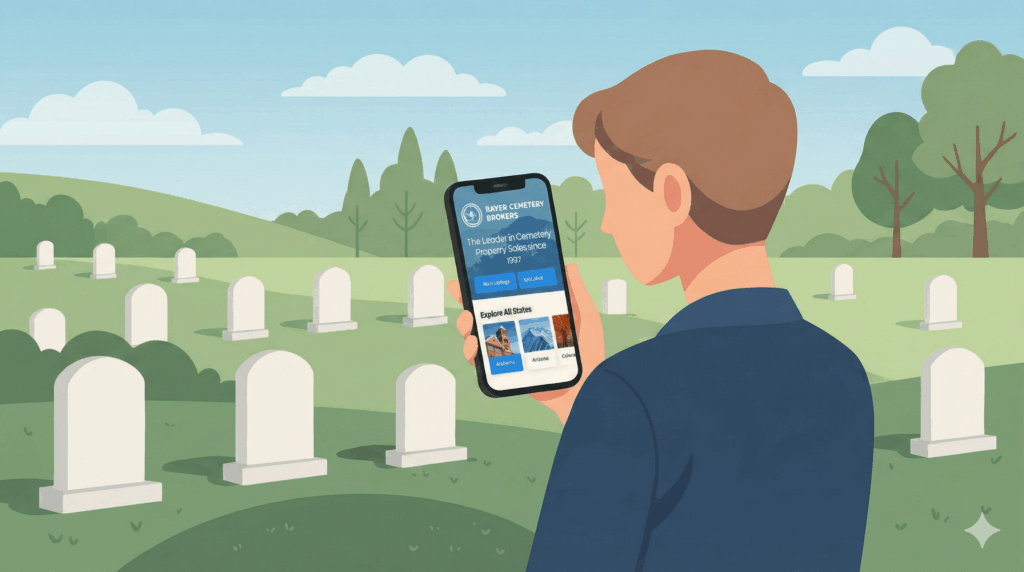
When valuing an inherited plot, don’t just look at the price tag. Look at the map.
Many inherited plots were purchased 30, 40, or 50 years ago. This puts them in a unique position regarding Supply and Demand.
The “Sold Out” Section Advantage
Cemeteries develop in phases. The oldest sections—often featuring large oak trees, historic statues, and central locations near the chapel—are usually “Sold Out.”
- The Problem for Buyers: A family might want to be buried near Grandma, who passed away in 1990. When they call the cemetery, the cemetery says, “Sorry, that section is full. We can only sell you a plot in the new expansion area.”
- A Possible Opportunity: If you inherit a plot in that “Sold Out” section, you may possess a scarce asset. Your resale plot may be the only way a buyer can purchase within that desirable lawn.
Sections with a lot of resale inventory (High Competition)
Conversely, if your plot is in a newer section where the cemetery still has thousands of unsold spaces, you face additional challenges. To sell your plot, it will need to be priced significantly lower than the cemetery’s retail price and buyers’ other options.
The Bayer Advantage:
California Brokerage: We pride ourselves on our 27 years’ experience and our deep relationships with industry professionals in the locations we serve. Our valuations take into account current and historical market conditions. We have insight into available inventory at highly specific locations (down to which plot type, or even whereabouts a plot is situated within a specific lawn.)
National Cemetery Plot Marketplace: When you create your listing, we encourage you to highlight the specific “Garden” or “Section” name. Our targeted Google Ads find buyers searching specifically for those historic sections.
Part 5: Marketing the Invisible (How to List It)
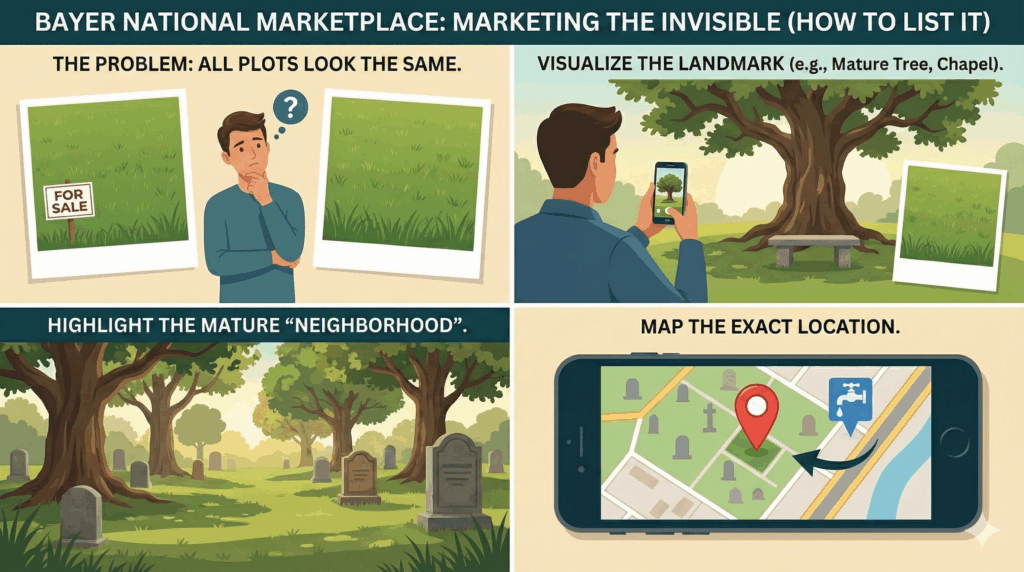
Selling a cemetery plot is difficult because you are essentially selling a patch of grass that looks identical to the patch of grass next to it. How do you make your listing stand out?
When you list on the Bayer’s Cemetery Plot Marketplace, you need to think visually:
- Don’t just photograph the grass. Take a photo of the nearest landmark (a large tree, a statue, or the chapel). This helps buyers orient themselves.
- Highlight the “Neighborhood.” Is the plot in an older, sold-out section? These are often more desirable than the new sections because they have mature trees and history. Mention this in your description.
- Map it Out. Use our listing tools to upload a map image with a pin drop. Buyers want to know exactly how close they are to the road or the water spigot.
Part 6: Taxes & The “Stepped-Up Basis”
Disclaimer: We are cemetery brokers. We do not provide legal or financial advice. Always consult a licensed tax professional, CPA, attorney and other industry professionals for advice regarding your specific situation. The following is a general description for information purposes only.
One of the biggest fears heirs have is the tax hit. “If my dad bought this for $500 in 1970 and I sell it for $5,000, do I owe tax on the $4,500 profit?”
Usually, the answer is No, thanks to the Stepped-Up Basis.
How It Generally Works
When you inherit property, the IRS typically “steps up” the value of the asset to its fair market value on the date of the original owner’s death.
- Original Cost: $500 (in 1970).
- Value when Dad died (2024): $5,000.
- Your “Cost Basis”: $5,000.
- You Sell it for: $5,000.
- Taxable Gain: $0.
This makes selling an inherited plot a smart financial move. You can often liquidate these assets tax-free. Whether you use our Cemetery Plot Marketplace or our California Brokerage service, getting this asset sold converts “dead capital” into usable cash without a major tax penalty.
Step-by-Step: How to Sell Your Inherited Plot
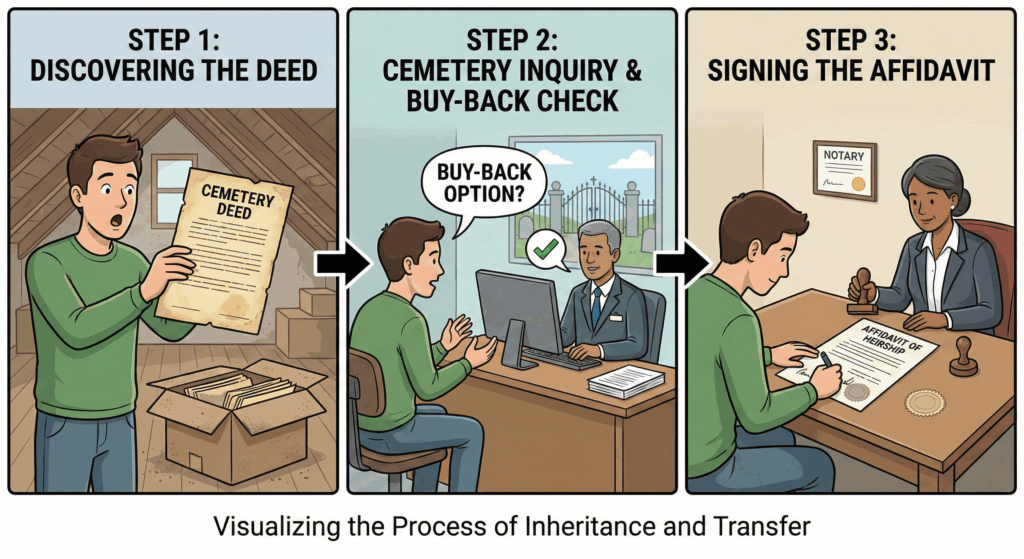
1. Locate the Deed
Find the original Certificate of Interment Rights. If it is lost, don’t panic. The cemetery office holds the master records.
2. Check for “Right of First Refusal”
Call the cemetery and ask: “Do you have the Right of First Refusal?” Some older contracts and some states require you to offer the plot back to the cemetery first. They will usually decline, but you need that decline in writing.
3. Choose Your Service Level
This is the most critical step. Are you going it alone, or do you need a partner?
- The DIY Risks: Listing on Craigslist or eBay opens you up to spam, scams, and legal headaches if you mess up the transfer paperwork.
- The Bayer Way: Choose the service that matches your location (see below).
4. List and Close
Once listed with us, we filter the leads. When a buyer is found, you (or we, as your broker) meet at the cemetery or coordinate remotely to sign the transfer papers and exchange funds.
Which Bayer Service is Right for You?

We are the only company in the industry that offers a hybrid solution. Please choose the option that matches your property’s location:
For Inherited Property in California
We Are Your Full-Service Broker. California Health & Safety Code (§ 8650) has strict rules about family interment plots. As a licensed brokerage, we take the burden off your shoulders.
- What We Do: We handle the Affidavits of Heirship, negotiate with the cemetery, find the buyer, and ensure the endowment fees are handled.
- Cost: We work have listing options starting at $0.
- Click Here to Start a California Brokerage Inquiry
For Inherited Property in All Other 49 States
Use Our national Cemetery Plot Marketplace. If you are outside California, we provide the platform and the marketing power. You act as the seller, but you do it on a professional stage with vetted leads.
Click Here to List on the National Cemetery Plot Marketplace
What We Do: We provide the listing platform, Google Ad marketing, and spam protection. We give you the visibility you need to sell privately.
Cost: A simple one-time listing fee (0% Commission).
Join the national Cemetery Plot Marketplace where serious buyers and sellers meet.
At Bayer Cemetery Brokers, we understand the importance of preserving the memory of loved ones. For over 27 years we have helped families in Southern California and beyond find the perfect resting place for their loved ones at the most cost-effective price.
If you’re interested in purchasing cemetery property, or if you have a burial plot you no longer need, we can help: Contact us here
Licensed and bonded by the California Cemetery and Funeral Bureau.